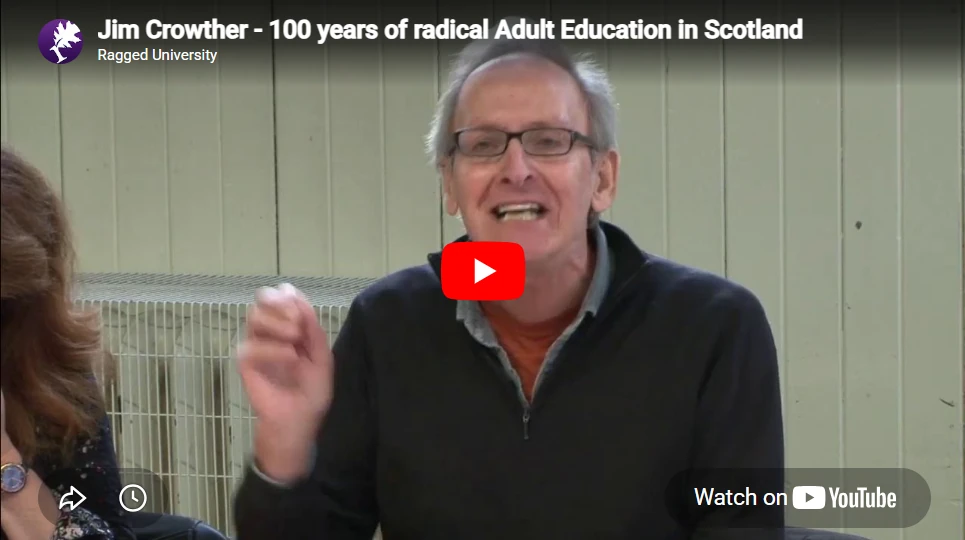
Sharon and Iain cover the origins and story of the research circle in a blog post on the Studies in the Education of Adults blog. This journal aims to examine “the education of adults, lifelong learning, and the nature of adult curriculum” via blog contributions.
You can view the original blog post at https://studiesintheeducationofadults.wordpress.com/2022/07/25/celebrating-resources-of-hope-the-story-and-place-of-a-research-circle/.
Introduction
Since Spring 2021, we have convened a research circle on ‘Building community, democracy and dialogue through adult lifelong education’ and organised a series of events to challenge dominant perspectives on lifelong learning. The Circle is made up of around 10 active members, drawn from backgrounds in adult, further and higher education, the voluntary and community sector and trade union education in different regions of the UK. We all have a deep commitment to social purpose education and our objective has been the sharing of experience and critical engagement, designed to explore and generate new and existing forms of practice in the generation of hope. Our activities form part of the continuing work of The Centenary Commission on Adult Education in the UK. Initially formed in 2018, and co-chaired by The University of Nottingham and University of Oxford, the Commission first met in 2018-19 and produced a final report “A Permanent National Necessity: Adult Education and Lifelong Learning for 21st Century Britain” (2019). A series of further events disseminated the report in 2020 and, that Autumn, the research circle grew out of one of these events.
The group has worked on a range of activities, including collecting resources/documents to support our Research Circle and the creation of background papers for events in 2021 and 2022. We have now organised a series of three further events between May and September 2022.
The context for our work
The wider histories, origin, and characteristics of research circles (see, for example, Holmstrand and Harnsten 1992, Harnsten 1994, Holmstrand, Harnsten and Lowstedt 2008, Bergman 2014) relate to our own collaborative work in two ways. Earlier research reported that the context of each research circle varied; ranging from studying a specific problem – and the needs of a particular group of workers in a single setting – to a national crisis of the public sector (Harnsten 1994). Our collective work has also begun from an explicit position: a sense that dominant forms of lifelong learning are an impoverished response to local, national, and international crises. This political imperative reflects Harnsten’s earlier emphasis on the place of research circles in Sweden as part of a ‘collective counterattack’ (1994, p.9) against the practices of a Swedish conservative government who threatened the achievements of the welfare state. Similarly, before our first event in May 2021, Clancy (2021) argued that the overall purpose of our Research Circle was to ask why adult education needs to be radically reshaped and how can inclusive forms of adult education, that engage marginalised communities, be re-built?
The focus of the Research Circle has been to consider the current state of higher, further and adult education (particularly in England) and ask if the spaces for education with a social purpose, with its emancipatory dimensions, are limited and restricted. If the answer to our question is ‘yes’, we have asked the crucial and central political question : ‘Why does adult education need to be radically reshaped?’ In 2021 three events, organised by the research circle on ‘Building community, democracy and dialogue through adult lifelong education’, took inspiration from speakers and participants from a wide range of voluntary and community organisations and adult, further and higher education. In these first events, between May and September 2021, we asked
- Why does adult lifelong education need to be radically reshaped, especially in the Covid era, and how?
- How does adult education link with and foster our democracy?
We emphasised the central importance of our shared histories, memories, and instances of previous struggles (Williams 1989, Goodson and Sikes 2001, Sanchez 2018). In a second series of events, between May and September 2022, we have built on our earlier work. With a collective title of ‘Dialogues for Democracy: Cultures and Ecologies in Crisis’ our provocations have been designed to both inspire and unsettle. Our emphasis, in each of the events in 2022, has been on
- scoping the crisis faced by lifelong education
- reviewing action being taken and further action needed.
In our debate, on different approaches to community adult lifelong education, we asked why – and how – does adult lifelong education need to be radically reshaped- especially in the COVID era? We widened the scope of our work. In May, we addressed ‘Health Inequalities in Communities’ and asked, ‘What is the role of Community Adult Education?’ and, in June, the challenges of ‘Ecological and climate emergency and environmental action’. Our final event in September related these debates to higher education. We asked what the roles of universities are- beyond social responsibility- in re-imagining different forms of radical public engagement.
Our collaborative practice, research and themes of the Special Issue
In an echo of Harnsten’s emphasis on the place of earlier research circles in Sweden, as part of a ‘collective counterattack’ (1994, p.9), another blog post (Clancy and Jones 2021) highlighted the power and richness of each presentation- after the first research circle event in May 2021. One of the Research Circle members summed up this vital role in his reflections after the event: “I felt all the presenters, in their different ways, were saying something similar: [we need] spaces in which dialogue, cooperative learning, democracy and community can begin to thrive”. Another participant emphasised: “Today has sown some seeds and demonstrated a collective impetus, for which I’m grateful ”.A further speaker also highlighted that through our collective action we can create a place for “remembering, not forgetting, past practices”, enabling us to store and share our memories of creative policy responses and practice.
This impetus draws on Williams’ resources of hope and continually remind us that “to be truly radical is to make hope possible rather than despair convincing” (Williams 1989, p.118). Reflecting on our work in 2021 and 2022, we pose two contemporary questions – with both a historical and contemporary resonance. These relate to the overall theme of the Special Issue: Who has the power to speak about lifelong learning and, if, our experiences are marginalised and minimised, how can we work collectively – as democratic educators – to re-build our voice for radical forms of adult lifelong education- inspired by Williams’ resources for a journey of hope and concept of the ‘democratic educator’ ? (Williams 1961).
In our collaborative work with other members of the Research Circle, we have continued to nurture spaces for engagement with one another (Gornall and Salisbury, 2012, p.138)- but these moments of ‘slowing down’ have contrasted sharply with a catalogue of other competing demands. However, in a further reminder of Harnsten (1994), we seek to keep alive these conversations which focus on making learning “part of the process of social change itself” (Williams 1983)- and we continue to develop ourselves within this process as brokers, advocates and critical thinkers. As Williams said,
There are ideas, and ways of thinking, with the seeds of life in them, and there are others, perhaps deep in our minds, with the seeds of a general death. Our measure of success in recognizing these kinds, and in naming them making possible their common recognition, may be literally the measure of our future (Williams 1993, p.338).
References
Bergman, L., 2014. The research circle as a resource in challenging academics’ perceptions of how to support students’ literacy development in higher education. Canadian Journal of Action Research, 15(2), 3-20.
Centenary Commission on Adult Education Report, 2019. Adult Education and Lifelong Learning for 21st Century Britain, University of Nottingham and University of Oxford.
Clancy, S., 2021. Fostering community, democracy and dialogue through adult lifelong education: Celebrating resources of hope, Unpublished background paper.
Clancy, S., and Jones, I., 2021. Community, democracy and dialogue through adult lifelong education: Celebrating Resources of Hope – blog post, June 2021.
Goodson, I., and Sikes, P., 2001. Life History Research in Educational Settings. Buckingham: Open University Press.
Gornall, L., and Salisbury, J., 2012. Compulsive Working, ‘Hyperprofessionality’ and the Unseen Pleasures of Academic Work, Higher Education Quarterly, 66(2), 135-154.
Härnsten, G., 1994. The Research Circle-Building Knowledge on Equal Terms. Stockholm: The Swedish Trade Union Confederation.
Holmstrand, L., and Härnsten, G., 1992. The Research Circle: Some educational perspectives In: P. Gam, A. Gullichsen, J. Toumisto, & M. Klasson (eds) Social Change and Adult Education Researchin Nordic Countries 1990/91. Linkoping : University of Linkoping.
Holmstrand, L., Härnsten, G. & Löwstedt, J. 2008. The Research Circle Approach: A Democratic Form for Collaborative Research in Organizations in Handbook of Collaborative Management Research. London: Sage.
Sanchez, A., 2018. Relative Precarity: Decline, Hope and the Politics of Work in Hann, C & Parry, JP. (Eds), Industrial Labor on the Margins of Capitalism: Precarity, Class and the Neoliberal Subject. New York & Oxford: Berghahn.
Williams, R., 1961/2011. The Long Revolution. Swansea: Parthian Books.
Williams, R., 1983. Towards 2000. London : Chatto & Windus.
Williams, R., 1989. What I Came to Say. London: Radius.
Williams, R., 1993. Culture and Society. London: The Hogarth Press.